


Bupyeong Market in Busan goes by a more colourful name: Kkangtong Market, the “tin can” market. It sits in Jung-gu, within roughly 700 metres (in a straight line) of two other famous markets, and it changes character after dark when a night market opens. This guide explains where the name comes from, what to expect by day and by night, what to eat nearby, and how to link the three markets in one trip.
Every hour, distance and phone number below comes from a named source, and we note the date it was checked. Where sources disagree or say nothing, we say so.
Where to Go: Bupyeong (Kkangtong) Market
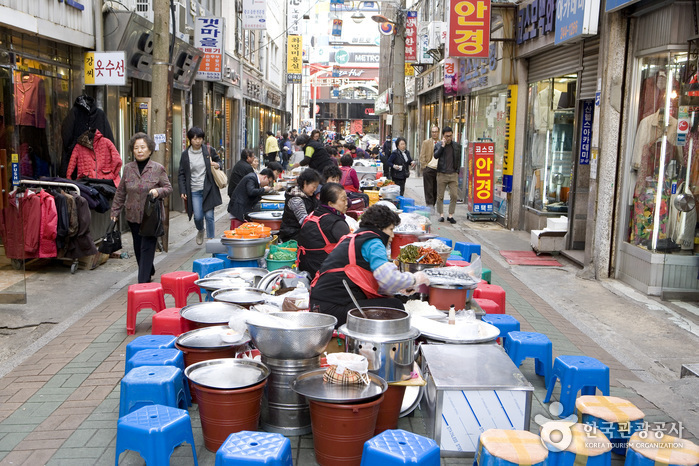
Why it is called Kkangtong
Kkangtong means “tin can”. According to the Korea Tourism Organization (KTO), the market earned that funny name when it sold a variety of imported canned goods from the United States, supplied for the US forces stationed in Korea during the Korean War. The same description says it was also known as Dottegi Market. KTO adds that all foreign products found in the country at that time were supplied from this market, and that because of its vast property and many rare goods that were hard to find anywhere else, it was also referred to as Gukje, or International, Market.
The market is smaller now, because many foreign products can be imported freely. KTO says the reputation remains, and some imported goods, including liquor, clothes, ornaments, accessories, fashion items and electronic goods, are still sold here.
By day
The listed opening hours are 08:00 to 20:00, and KTO adds that hours vary by store. The market is open all year round, with a public parking lot and restrooms available. The address is 48 Bupyeong 1-gil, Jung-gu, and the information line is +82-51-243-1128.
After dark: the night market
A night market opens from 19:30 to 23:30, at the public parking lot and in Arcade 2 of the market. KTO’s description of it, which may reflect older counts, is a 110-metre street market with 11 kiosks selling Korean food, 6 kiosks selling international food such as Japanese and Filipino dishes, and 13 vendors selling clothes and accessories. The market entrance is lit with bright LED lights, and KTO says a magic show and a guitar performance take place twice a day, at the entrance and at the four-way intersection inside the market.
We could not confirm whether the night market runs on public holidays, so check before you plan a trip around it.
Where to Eat: Gukje Market Food Street and a Pork Soup Stop
Gukje Market Food Street (국제시장 먹자골목)
Gukje Market Food Street is about 190 metres from Bupyeong Market, measured in a straight line from the coordinates in the KTO data. KTO calls it one of Busan’s traditional markets’ most famous food streets, with more than 60 years of history, and lists an opening date of May 1950 (the two figures do not quite match, so treat the exact age as approximate).
The dishes it is known for, per KTO, are:
- Chungmu gimbap, served with a sweet and sour squid salad
- Sweet-and-spicy tteokbokki
- Milmyeon (wheat noodles)
- Dwaeji gukbap (pork and rice soup)
- Sundae
- Patbingsu (shaved ice with red beans)
- Bibim dangmyeon (spicy glass noodles)
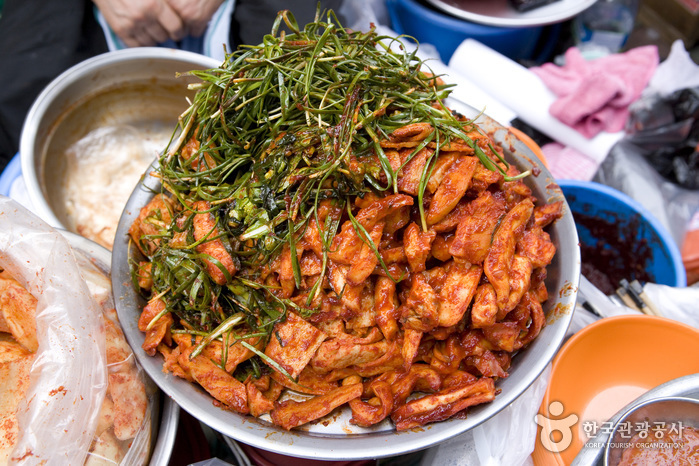
The dishes are enjoyed on small stools next to the street stalls, and KTO calls the sight of diners lining the stalls one of the defining views of Korea’s traditional markets. Clothing, shoes and accessories are sold here too.
Two practical notes. The food street is closed on the first and third Sundays of every month, and in October 2026 those are 4 October and 18 October. Hours vary by store, and no parking is available. The information line is +82-51-245-7389.
A pork soup stop: Yangsanjip (양산집)
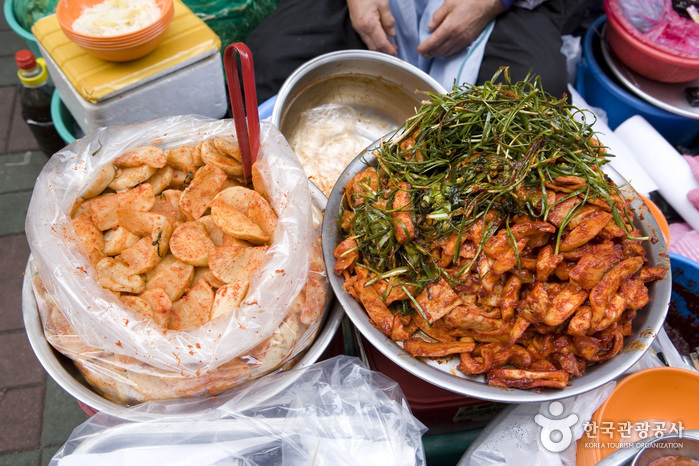
Yangsanjip is about 90 metres from Bupyeong Market in a straight line, at 30 Jung-gu-ro 47beon-gil, Jung-gu. KTO describes it as a long-standing dwaeji gukbap restaurant beloved by both the vendors and the visitors of Kkangtong Market. It is small, so waiting for a seat is often necessary, and regulars are described as more than willing to wait.
The popular item is the suyuk baekban, a boiled pork set that comes with soup, rice, and the boiled pork slices served separately. The listed menu also includes rice in soup with meat, and rice and soup served separately.
The listing gives these details: open 10:00 to 20:00, break time 15:00 to 17:00, last order at 19:30, and closed every Tuesday. It has 20 seats and no on-site parking. Phone: +82-51-245-8294. We have no price list, so we cannot give you prices.
Plan Your Visit: Three Markets in One Trip
The three markets are close enough to link into one route. The order below is our suggestion, not an official route. All the distances here are straight-line estimates from the KTO coordinates, not walking distances, so check a map app for the real route:
- Start at Bupyeong Market for the daytime stalls.
- Snack at Gukje Market Food Street, about 190 metres away.
- Walk on to Jagalchi Market, about 700 metres from Bupyeong.
- Return to Bupyeong for the night market from 19:30.
Jagalchi Market (자갈치시장)
Jagalchi Market sits on the seaside road in Jung-gu at 52 Jagalchihaean-ro. KTO calls it one of the largest seafood markets in Korea, selling both live and dried fish. After the Korean War the market solidified itself as a fish market, and most of the people who sell fish are women, known as Jagalchi Ajumeoni. Visitors can eat fresh raw fish at the market, and women can still be seen selling mackerel and sea squirts from wooden boxes outside.
It is open 05:00 to 22:00 and closed on the first and third Tuesdays. Parking is available, restrooms are on each floor, and the information line is +82-51-245-2594. If you have allergies, ask staff about ingredients before you order raw fish or shellfish.
Timing at a glance
- Bupyeong Market: 08:00 to 20:00 by day, varying by store. Night market 19:30 to 23:30.
- Gukje Market Food Street: closed the first and third Sundays of every month.
- Yangsanjip: 10:00 to 20:00, break 15:00 to 17:00, last order 19:30, closed Tuesdays.
- Jagalchi Market: 05:00 to 22:00, closed the first and third Tuesdays.
These details were checked on 30 September 2026. Come in the afternoon for the stalls, then return for the night market from 19:30. That is a suggestion for pacing, not something the sources state.
First-time visitor tips
- Check the calendar first. Two of the markets have closed days: the food street on the first and third Sundays, and Jagalchi on the first and third Tuesdays. Yangsanjip closes every Tuesday, so a Tuesday visit would rule out two of the stops.
- Do not expect a classic old-fashioned market. The market is smaller now, though some imported goods are still sold. Our suggestion: treat the history as background and the food and the night market as the main reasons to come.
- Eat outside the break. Yangsanjip pauses from 15:00 to 17:00 and takes last orders at 19:30. Our suggestion is to plan the pork soup either before mid-afternoon or after 17:00.
- Pace yourself. Two sessions suit the market better than one long one: stalls by day, then the night market from 19:30. Skip Jagalchi if energy is low, since it is the furthest of the three.
- Ask before ordering raw fish or shellfish if you have allergies, as the listing advises.
FAQ
Why is it called the tin-can market?
Kkangtong means “tin can”. KTO says the market sold imported canned goods from the United States, supplied for US forces during the Korean War.
When does the night market run?
It opens from 19:30 to 23:30, at the public parking lot and in Arcade 2. We could not confirm whether it runs on public holidays, so check before building a trip around it.
Can I visit all three markets in one day?
They are close enough in a straight line, at roughly 190 and 700 metres from Bupyeong. Those are not walking distances, and we have no walking times, so use a map app. The order we suggest is our own, not an official route.
What should I eat?
KTO lists dishes for the food street such as Chungmu gimbap, tteokbokki and dwaeji gukbap, and describes Yangsanjip’s boiled pork set as its popular item. We have no prices for either, so we cannot say what a meal costs.
Are there photos of Bupyeong Market in this guide?
Not of the market itself. KTO has none, so the pictures show the Gukje Market Food Street area nearby.
What we could not confirm: check these before you go
- Walking routes and times between the markets. We only have straight-line distances.
- Whether the night market runs on public holidays, and whether the kiosk counts in KTO’s description are current.
- Prices at Yangsanjip and at the food street stalls.
- Photographs of Bupyeong Market itself. KTO has none, so the pictures in this guide show the Gukje Market Food Street area, about 190 metres away.
Before You Go
Kkangtong Market rewards an afternoon and an evening more than a quick stop: the daytime stalls and a bowl of pork soup first, the night market afterwards, and Gukje and Jagalchi in between if you have the energy. Check the closed days, especially the first and third Sundays and Tuesdays, and keep the schedule loose.
More short guides for first-time visitors are on Instagram at @rolo.koreaguide.
Related guides
- Gukje Market and Gukje Market Food Street, Busan
- Bujeon Market Town and Jeonpo Cafe Street, Busan
- Busan Metro for Visitors
Sources
- Korea Tourism Organization, TourAPI (English service): Bupyeong (Kkangtong) Market (content ID 1884501), Yangsanjip (3433012), Gukje Market Food Street (1024670), Jagalchi Market (2382544). Checked 30 Sep 2026. Photographs: KTO, KOGL Type 3, used unaltered.
- Distances: straight-line calculations from the coordinates in the KTO data. The closed-day dates for October 2026 are worked out from the calendar.

