


Gukje Market is, according to KTO, one of Korea’s largest markets, and it is not a single building. It is a maze of alleys and halls in Jung-gu, Busan, and it is easy to get lost in. This guide covers what the market is, what people eat on its food street, and how to fit it together with Jagalchi Market on the same afternoon.
Every hour, place name and date below comes from a source we name at the bottom of the page, checked on 30 September 2026. Where our sources disagree or say nothing, we say so in the text and again in a separate list. Some details from our own Instagram posts could not be traced to a source, so they are in that list rather than in the guide.
Our Family Market Day: Fish, Soup and Shared Snacks
We took our children, aged 5 and 3, around Gukje Market, Bupyeong Kkangtong Market and Jagalchi on the same outing. At Jagalchi, our younger child was a little frightened by the moving fish and hagfish, but kept asking to look again. Some stallholders greeted the children warmly, which is one of the things we remember from the day.
We ate gukbap at Yangsanjip and shared bibim-dangmyeon as a snack. We also walked through Bosu-dong Book Street. This is our family’s sequence, not a timed itinerary: the children’s interest decided how long we stopped.
Traffic around the markets was heavy in our experience. I would choose a car park before setting off and explore on foot from there. Bringing a stroller did not remove the need to work around crowded market lanes.
Family notes added 15 October 2026. The visit date was not recorded. The children were aged 5 and 3 at the time.
Where to Go: Gukje Market
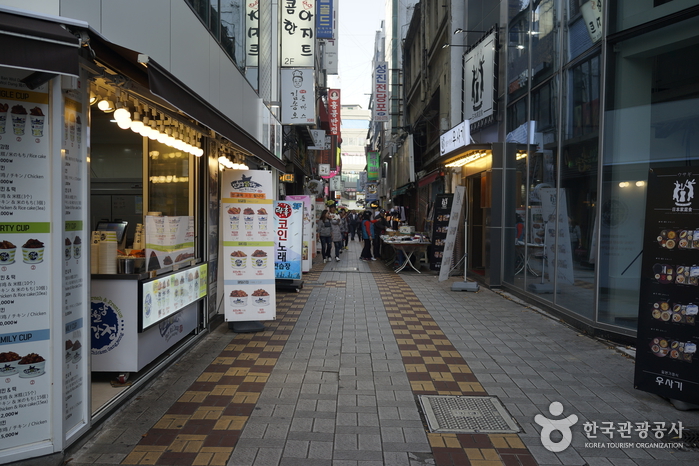
The photo above is the one we can safely use from the Korea Tourism Organization (KTO): it comes from the listing for Gukje Market Food Street, but we cannot say which lane it shows. The main Gukje Market listing has no photographs at all. Some of our Instagram posts showed a clothing alley called Jeolmun-ui-Geori (Youth Street). It is not the market itself, and we have not reused those pictures here.
How the market began
KTO’s account is that the market first formed after Korea’s liberation from Japanese administration, when people gathered to trade overseas goods left by the Japanese or brought home by Koreans returning from abroad. After the Korean War, refugees who had fled to Busan set up stalls to make a living by selling smuggled or imported goods, and this grew into today’s market. “Gukje” means “international” in Korean. KTO calls it one of Korea’s largest markets and describes it as divided into two wings.
Our earlier posts gave two specific dates, 1945 for the first stalls and 1950 to 1953 for the rapid growth. KTO’s text gives no years for those stages. The other official source we checked, Visit Busan, tells a slightly different story: it says the market formed after the Korean War, as US army items and other goods collected in the refugee capital of Busan. KTO’s data also lists an opening date of 1948. These accounts overlap but do not match exactly, so treat the origin story as approximate.
The film “Ode to My Father”
The 2014 film Ode to My Father has the Korean title 국제시장 (Gukje Sijang), literally “Gukje Market”. Wikipedia says the film follows one ordinary man’s life through South Korean history from the 1950s to the present day, and was filmed notably at Gukje Market. Visit Busan says the film centres on the market and that its success brought the market a second golden era. We did not check the film’s plot in any further detail, and our earlier line about “a family who settled here after the war” is not something we could confirm.
What you will find
KTO lists the goods for sale as agricultural produce, electronics, general goods and cosmetics, among others. Our posts described the alleys as historically specialised by trade, in imported goods, tools, fabric and clothing. We could not find that claim in KTO or Visit Busan, so we do not repeat it as fact. What we can say from the sources is that it is a large, dense market with a wide mix of goods.
From my own visits. Gukje Market is a familiar place because it appeared in a well-known Korean film. You can find almost anything here. It connects easily with nearby Nampo-dong, so it is easy to explore on foot. In the evening we would go on to the Bupyeong Kkangtong Night Market for street food. We came here often in the early days of dating my wife.
What to Eat: Gukje Market Food Street
Gukje Market Food Street (국제시장 먹자골목) sits at 36 Junggu-ro, roughly 70 metres from the main market listing in a straight line, going by the coordinates in KTO’s data. KTO says it has more than 60 years of history and is one of the most famous food streets among Busan’s traditional markets. Dishes are eaten on small stools next to the street stalls.
KTO names these dishes:
- Chungmu gimbap, served with a sweet and sour squid salad.
- Sweet-and-spicy tteokbokki (rice cakes).
- Milmyeon (wheat noodles).
- Dwaeji gukbap (pork and rice soup).
- Sundae (blood sausage).
- Patbingsu (shaved ice with red beans).
- Bibim dangmyeon, described as Busan’s iconic spicy glass noodles.
Visit Busan’s page for the market adds chungmu gimbap, bibim dangmyeon, eomuk (fish cake), tteokbokki, fritters and blood sausages.
Where our posts went further than the sources
Our What to Eat posts described chungmu gimbap as plain seaweed rice rolls served with spicy stir-fried squid and radish kimchi, and said the dish began in Tongyeong. KTO’s food street page mentions a sweet and sour squid salad and does not mention radish kimchi or Tongyeong. The Tongyeong origin is widely repeated, but we did not verify it in a source, so we leave it out. If you order chungmu gimbap, expect a side of squid but check what comes with it.
Our posts also described bibim dangmyeon as served cold or at room temperature in a savoury-sweet sauce, and odeng as skewers in warm broth. KTO says only that bibim dangmyeon is spicy glass noodles, and neither source describes how odeng is served. Both are common dishes, but we cannot confirm the details at these stalls.
We have no verified stall names, menus or prices for the food street. If you want a specific stall, that is something to look up on the day.
Plan Your Visit
Getting there
Visit Busan says to take Busan Metro Line 1 to Jagalchi Station, use Exit 7, and walk for about seven minutes to Gukje Market. It also lists buses 15, 40, 86, 126 and 186 with a walk of about four minutes. Visit Busan says to get off at the Gukje Market stop and walk about four minutes (re-read 1 October 2026).
Our earlier posts said Nampo Station on Line 1 is a short walk away. We did not find that in our sources, so we cannot confirm the distance from that station. Jagalchi Station’s Exit 7 route is the one we can source.
Opening days and hours
- Gukje Market: KTO lists 09:00 to 20:00, varying by shop. Visit Busan lists 09:00 to 20:00 and Sunday as the closing day, though its own page also says “every day”, so the two entries do not fully agree. The information line is +82-51-245-7389, and KTO lists a public car park and toilets.
- Sundays: both KTO and Visit Busan list Sunday as the rest day for the main market.
- The food street is different in KTO’s data. For Gukje Market Food Street, KTO lists the closing days as the first and third Sundays of every month, with hours that vary by store. Our posts said “closed every Sunday” for the food alleys as well. The main market listings support that; the food street listing does not. Since 1 October 2026 is a Thursday, this does not affect that day, but it matters for a Sunday plan. Treat Sunday as risky at both and check on the day.
Adding Jagalchi Market
Jagalchi Market is at 52 Jagalchihaean-ro, about 0.6 kilometres from Gukje Market in a straight line by the KTO coordinates. Our posts said 5 to 10 minutes on foot. That figure is our estimate for a short walk and was not measured by a source, so check the route on your map app. KTO describes Jagalchi as one of the largest seafood markets in Korea, selling live and dried fish, and says vendors are mostly women known as Jagalchi Ajumeoni. KTO lists it as open 05:00 to 22:00, closed on the 1st and 3rd Tuesdays, with an information line of +82-51-245-2594.
If you are visiting in October, the Busan Jagalchi Festival is held every October at Jagalchi Market for about four days, according to Visit Busan. The Visit Busan page we read showed only 2025 dates, and we found no official 2026 dates. Confirm them with Visit Busan closer to your trip.
A simple order, as a suggestion
This is our suggestion, not a sourced itinerary. Arrive at Jagalchi Station Exit 7, walk to Gukje Market, eat on the food street, then walk on to Jagalchi in the afternoon. Keep cash handy in case a stall does not take cards (we could not find a source on card acceptance).
First-time visitor tips
- Avoid Sundays. Both KTO and Visit Busan list Sunday as the rest day for the main market, and the food street has its own closing days, so a weekday is the safer choice.
- Arrive at Jagalchi Station Exit 7. It is the one route we can source, and it puts you a short walk from the market.
- Expect a maze. The market is a set of alleys and halls rather than one building, so, in our view, do not try to see all of it.
- Eat on the food street, then decide about Jagalchi. Our suggestion is to keep Jagalchi for the afternoon, and only if you still have energy.
- Keep cash handy and check dishes. We found no source on card payment or on how each dish is served at the stalls.
FAQ
How do I get to Gukje Market?
Visit Busan says to take Busan Metro Line 1 to Jagalchi Station, leave by Exit 7 and walk for about seven minutes. Some buses stop about four minutes away.
When is it open?
KTO lists 09:00 to 20:00, varying by shop, with Sunday as the rest day. Visit Busan’s page also says “every day”, so check by phone on +82-51-245-7389.
What should I eat on the food street?
KTO names dishes such as chungmu gimbap, tteokbokki, milmyeon, dwaeji gukbap and sundae. We have no verified stall names, menus or prices, so choose on the day.
How far is Jagalchi Market?
About 0.6 kilometres in a straight line. We have no measured walking time, so check a map app.
Is the Jagalchi Festival on during my visit?
It is held every October for about four days, according to Visit Busan. We found no official 2026 dates, so confirm them closer to your trip.
What we could not confirm
- Origin dates. The years 1945 and 1950 to 1953 in our posts are not in KTO’s text, and Visit Busan’s account differs.
- Alley specialities (imported goods, tools, fabric, clothing) as a historical pattern.
- The film plot detail about a family settling in the market after the war.
- The Tongyeong origin of chungmu gimbap, and the “radish kimchi” and “spicy stir-fried squid” description. KTO says sweet and sour squid salad.
- How bibim dangmyeon and odeng are served at the stalls.
- Stall names, menus and prices on the food street.
- Nampo Station as a short walk from the market.
- Signage language, English menus and card payment. Our posts said signage is mostly Korean-only and card acceptance varies by stall. We found nothing on this.
- The walking time to Jagalchi (our 5 to 10 minutes).
- The 2026 Jagalchi Festival dates.
- Photographs of the market itself. KTO has none for the main listing.
Before You Go
Gukje Market rewards a slow afternoon more than a checklist. Go on a day other than Sunday, eat on the food street, then walk on to Jagalchi if you still have energy. Check the hours by phone, and treat everything in the list above as unconfirmed until you have seen it yourself.
The Instagram version of this guide is a quick set of cards at @rolo.koreaguide.
Related guides
Sources
- Korea Tourism Organization, TourAPI (English service): Gukje Market (content ID 705873), Gukje Market Food Street (1024670), Jagalchi Market (2382544). Checked 30 Sep 2026. Photograph: KTO, KOGL Type 3 (from the listing for content ID 1024670), used unaltered.
- Visit Busan, “Gukje Market bustling with energy” (visitbusan.net, page uc_seq=399): checked 30 Sep 2026 and re-read 1 Oct 2026. Used for hours, Sunday closure, Jagalchi Station Exit 7 route, bus numbers and the film’s link to the market.
- Visit Busan, Busan Jagalchi Festival page (visitbusan.net, page uc_seq=411): checked 30 Sep 2026. It showed 2025 dates only.
- Wikipedia, “Ode to My Father”: checked 1 Oct 2026, for the 2014 release, the Korean title, the film’s summary and the filming location only.
- Distances: straight-line calculations from the coordinates in the KTO data.

