


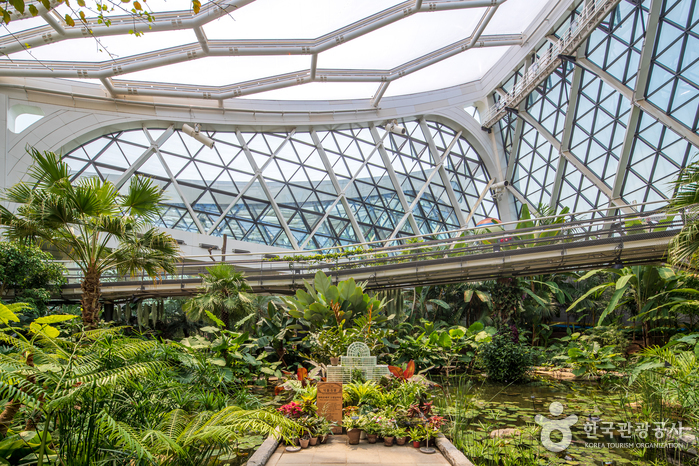
Yes—as a planning approach, treat them separately. Seoul Botanic Park (서울식물원) combines a public park and botanical garden, but the October 2026 Korea Tourism Organization listing gives different operating information for its outdoor areas and its greenhouse and themed garden. A single opening time does not describe every part of the destination. That distinction matters when deciding what you want to see and when to arrive.
This guide answers one practical question: how can you make an outdoor park plan without assuming the greenhouse will also be open? The starting point is the dated tourism listing, followed by a check of current entry and closure notices. The listing helps explain the distinction; it does not establish that every area will be accessible on your chosen day.
First decide what your visit depends on
Before choosing an arrival time, decide whether the greenhouse is essential to your plans. If it is, its listed opening hours, last admission and Monday closure should shape your decision. If your interest is the outdoor park, begin with the separate information for the forest, lake and wetland areas, then check notices affecting those areas.
This is a planning choice rather than a suggested route. There is no need to combine every part into one outing. Equally, an outdoor visit should not be described as guaranteed simply because the dated listing says those areas are open year-round. Keep the difference between a general annual schedule and current access conditions clear when making arrangements.
What the dated listing says about Mondays
The October 2026 Korea Tourism Organization listing states that the greenhouse and themed garden are closed on Mondays. That is a recorded weekly closure, so a Monday plan should not assume entry to either area. Checking current notices is useful, but it should not turn that clear listed closure into a vague suggestion that they might be closed.
The same listing describes the outdoor forest, lake and wetland areas as open all year round, while directing readers to the official website for schedules. These are separate statements about separate parts of the park. The greenhouse closure does not establish a closure for every outdoor area, and the outdoor annual schedule does not establish greenhouse access.
Use seasonal hours for the right part
For the greenhouse and themed garden, the dated listing gives hours of 09:30–18:00 from March through October and 09:30–17:00 from November through February. It also states that last admission is one hour before closing. Keep these details together: the seasonal closing time and the admission cutoff answer different planning questions.
An arrival before closing is not necessarily an arrival before last admission. When considering the greenhouse, check the entry cutoff as well as the closing time. Do not apply these greenhouse and themed garden hours to the outdoor forest, lake or wetland areas; the listing presents their schedule separately. Current notices remain the next check before relying on any of these dated operating details.
Check notices with specific questions
Rather than asking only whether the park is open, look for information about the part you intend to enter. For the greenhouse and themed garden, the useful questions concern the chosen weekday, seasonal hours, last admission and any closure or entry notice. For an outdoor plan, look for notices affecting the outdoor areas you hope to use.
The October 2026 listing does not establish current ticket prices, booking arrangements or future entry availability. Leave those details undecided until you can consult current information. A photograph of the destination also cannot answer an entry question. Use the schedule and notices to make access decisions, and treat images as illustrations rather than evidence of present operating conditions.
Keep an outdoor alternative genuinely separate
If the greenhouse is the main reason for going, an outdoor plan is a different choice, not an equivalent replacement. Decide in advance whether you would still want the outing without greenhouse entry. This avoids building a day around an assumption that the outdoor park and greenhouse share one schedule or offer interchangeable experiences.
If the outdoor park is your main interest, you can organize your questions around that plan without adding an unsupported greenhouse stop. There is no need to promise a particular walking duration or a complete circuit. The dated listing supports the distinction between areas; it does not supply a timed itinerary or establish conditions for a future visit.
Keep parking information in perspective
The October 2026 listing records parking with a capacity of 184 spaces. That figure describes listed capacity, not an available space for your arrival. It also does not establish current charges, parking restrictions or whether a particular entrance will suit your plans. If driving, check current parking information separately from the greenhouse schedule.
For the same reason, this guide does not add station exits, exact walking times or transport fares. Those details are not necessary to answer the central question about separate park and greenhouse planning. Keeping the plan focused makes the remaining decisions clearer: which part matters to you, what its listed schedule says, and what current notices need checking.
Your planning checklist
Start by choosing between an outdoor-focused visit and a visit that depends on greenhouse entry. For the latter, keep the listed Monday closure, seasonal hours and last admission rule together. For the former, remember that the outdoor areas have a separate year-round listing accompanied by a direction to consult the official website for schedules.
Before finalizing arrangements, check current entry and closure notices for your intended areas. Keep parking capacity separate from parking availability, and avoid treating dated hours as a promise about a future day. Source: Korea Tourism Organization, October 2026 tourism listing, available through https://english.visitkorea.or.kr/. Save this checklist to keep your outdoor park and greenhouse decisions separate.

