


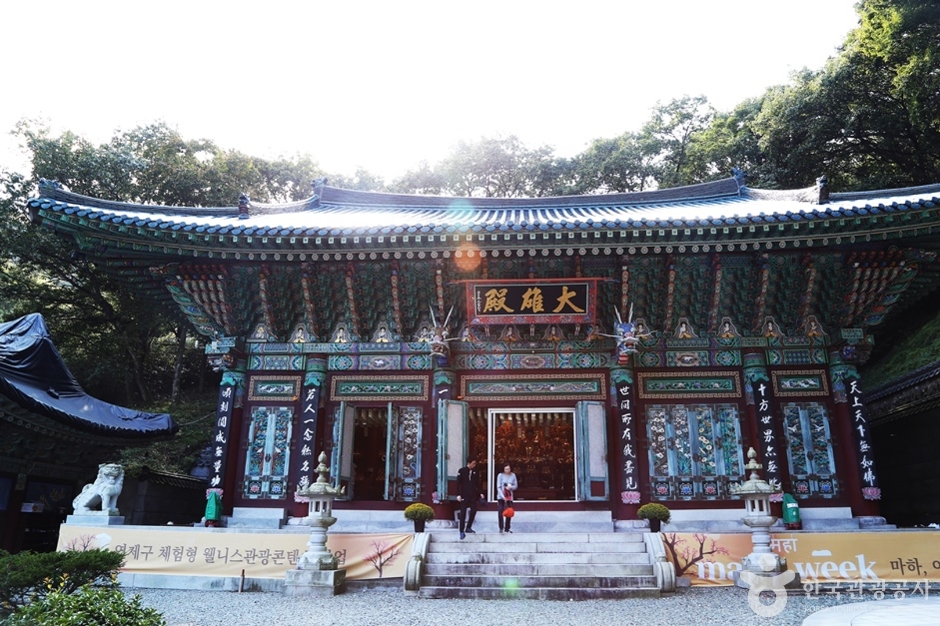
Mahasa Temple (마하사) is a Buddhist temple at 138 Bongsu-ro in Yeonje-gu, Busan. The Korea Tourism Organization (KTO) says it belongs to the Jogye Order (조계종) of Korean Buddhism, and Visit Busan, the city’s official tourism site, describes a forest trail up to it from Bongsu-ro. The listings we used do not rank it among Busan’s best-known temples, so this guide simply collects what they say about it.
We checked the sources on 3 October 2026. We have not visited, so this is a source summary and not a review. Where the two sources we used say different things, we give both. The listings are short, and we mark every gap instead of filling it with guesses.
What It Is and How Old It Is
The Korea Tourism Organization (KTO) says the temple’s founding and changes are recorded in the roof-beam text of the main hall, and that the record says the monk Ado founded it. KTO says all the buildings burned down during the Imjin War (the Japanese invasions that began in 1592) and were then restored in stages.
KTO lists three later rebuilding efforts. In 1970 a monk named Munseong rebuilt the main hall, the Eungjinjeon hall (응진전), a hall called Daebang, the monks’ quarters and a dining hall. In 1985 a monk named Jiyeon built the bell pavilion and restored a small hermitage called Banyaam. In 1998 a monk named Gyeongmin rebuilt the main hall and the Samseonggak shrine (삼성각).
Visit Busan, the city’s official tourism site, says the temple was first built in the Silla Dynasty and was burned in the Imjin War, then rebuilt gradually in the 18th and 19th centuries. That differs from KTO’s list of 20th-century rebuilds, though the two may describe different buildings. We do not try to settle it. If the date matters to you, ask the temple.
What You See
KTO says the temple did not follow the traditional temple layout because it stands on mountain terrain and has been rebuilt several times, but that it makes good use of a narrow precinct. It describes the main hall, the Daeungjeon (대웅전), as five bays wide and three deep with a hip-and-gable roof. The photo at the top of this guide shows the front of a hall carrying a 大雄殿 sign, which matches that name, though the photo does not say which year it was taken.
KTO says the grounds keep a number of cultural properties. These include a stone statue of the Shakyamuni Buddha with two attendants in the main hall, stone arhat statues and a wooden seated Shakyamuni in the Eungjinjeon, and several paintings, among them a painting of the assembly on Vulture Peak and a set of paintings of the Sixteen Arhats. We did not find which of these can be seen by visitors or at what times, so we cannot say what is open to see on a given day.
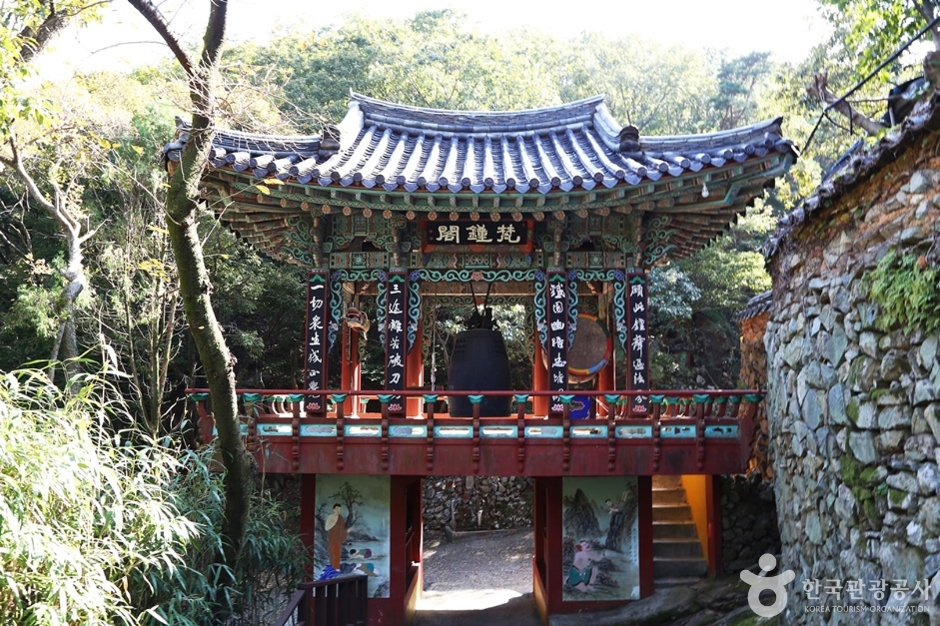
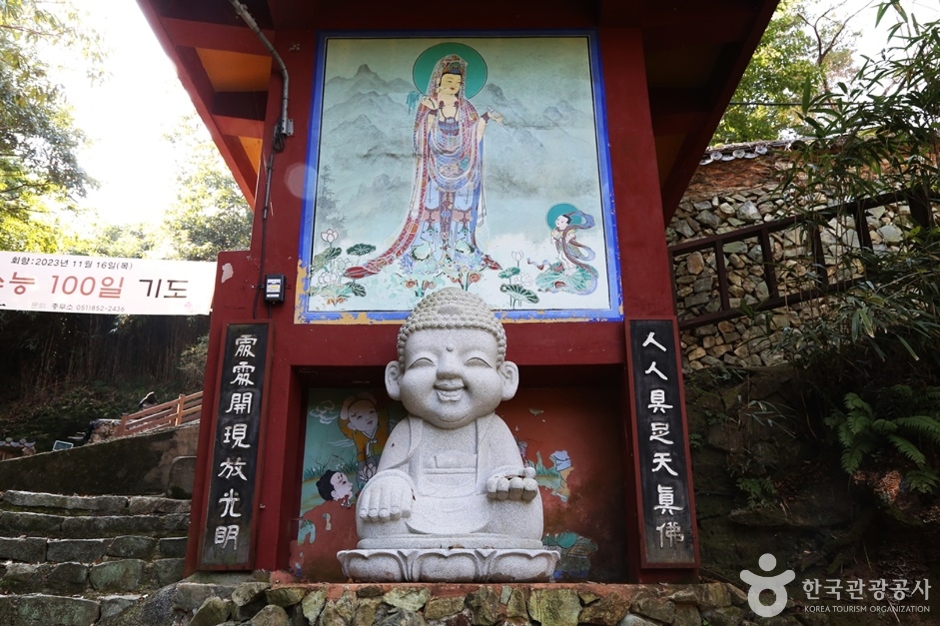
The bell pavilion above is one of the listed features, and Visit Busan mentions the sound of the temple bell as a memory from the walk down the mountain path. It also says that, as you climb the forest trail from Bongsu-ro, you pass a welcome banner and a smiling Buddha statue. The statue in the first photo may be that figure, but the listings do not say so.
Visit Busan also mentions a wellness program that is updated each year, with activities such as meditation and temple food. That is Visit Busan’s description. We did not find the current schedule, prices, languages or booking rules, and we make no claim about its effects. Contact the temple if you are interested.
Getting There
Visit Busan lists this route:
- Take Busan Metro Line 1 to Yangjeong Station (양정역) and leave by Exit 4.
- From Exit 4, take bus 20, 62 or 57.
- Transfer at Shin-ri Samgeori to the Yeonje-gu 2 village bus.
- Walk about 8 minutes from the stop, which Visit Busan’s English page calls “Mahasa Station”.
The “Mahasa Station” wording looks like a bus stop rather than a metro station, but the page does not say. We did not find the names of the stops where you get off the first bus, the ride times, or bus frequency, so check a map app before you go. KTO gives the address as 138 Bongsu-ro (봉수로 138), Yeonje-gu. For card basics on Busan transport, see our Busan metro and T-money guide.
Visit Busan lists a parking lot and a ramp, and notes parking at a cafe called Cafe EL 16.52. KTO lists parking as possible and says strollers are not possible at the temple. We could not confirm what that means in practice, such as whether steps or slopes block the way, so check with the temple if you plan to bring one.
Hours, Fees and Contact
KTO lists the temple as open at all times and open all year. We found no entrance fee in either source. The phone number is +82-51-852-2436, a number that may be hard to reach from abroad. We did not find an English website or confirmation that English help is available.
First-Timer Tips
These are our suggestions, not sourced facts.
- Go in daylight. The temple is on a mountain slope, and we found no source on lighting or path conditions.
- Wear shoes with grip. We did not find path details, but the setting is a slope.
- Dress modestly and keep your voice low in the halls. We found no official rules for Mahasa, so follow any signs and staff.
- Ask before taking photos inside a hall.
- Check the bus route the day before. We could not verify the stops.
FAQ
Is Mahasa Temple free? We found no fee in KTO or Visit Busan, but neither says outright that entry is free.
Is it open every day? KTO lists it as open all year and always accessible.
How do I get there? Visit Busan lists Yangjeong Station Exit 4, then bus 20, 62 or 57, then the Yeonje-gu 2 village bus, then an 8-minute walk.
Who founded Mahasa? KTO says the roof-beam record names the monk Ado. Visit Busan says the temple was first built in the Silla Dynasty.
Can I join the wellness program? Visit Busan mentions a yearly program but gives no schedule. Contact the temple.
What We Could Not Confirm
- Exact opening hours and whether entry is free.
- Which cultural properties visitors can see, and when.
- The wellness program’s schedule, price, languages and booking rules.
- The stop names, ride times and frequency on the bus route.
- Path conditions, steps and stroller access.
- English help or an English website.
Related guides
- Beomeosa Temple Guide
- Seonamsa Temple in Seomyeon
- Busan Citizens Park and Samgwangsa
- Busan Metro for Visitors
We post short first-timer guides on Instagram too: @rolo.koreaguide.
Sources
Checked on 3 Oct 2026.
- Korea Tourism Organization, TourAPI (Korean service): Mahasa Temple, Busan (content ID 304695). Photographs from this listing (KOGL Type 3) used unaltered.
- Visit Busan (official Busan tourism site), Mahasa Temple: https://www.visitbusan.net/en/index.do?menuCd=DOM_000000301001001000&uc_seq=2078&lang_cd=en .

