


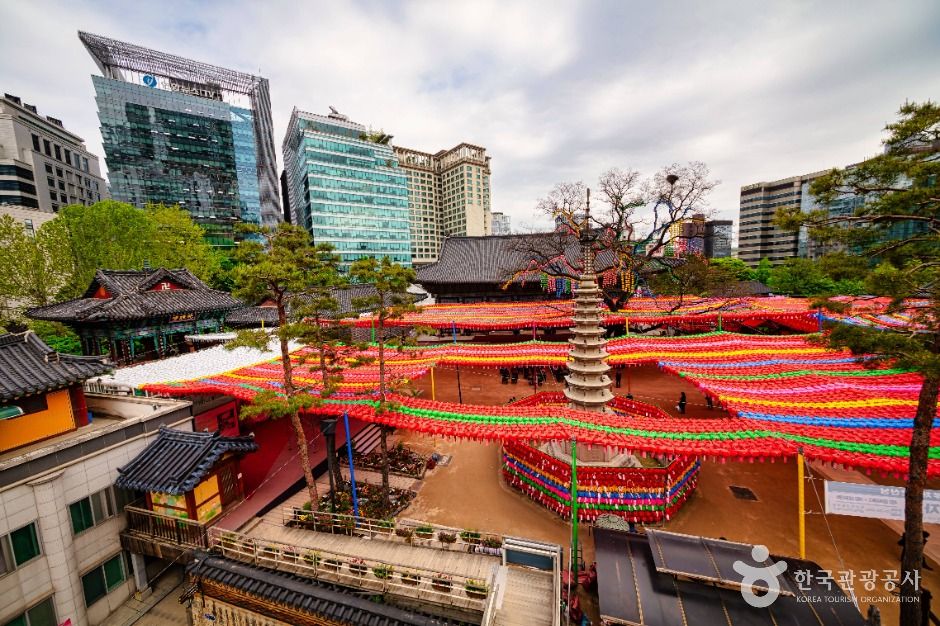
Jogyesa (조계사) is a Buddhist temple in the middle of Jongno, one of the busiest parts of central Seoul. The Korea Tourism Organization (KTO) says it is the head temple of the Jogye Order, the main Buddhist order in Korea. This guide covers what the sources say you will see, when it is open and how to get there.
We have not visited it for this guide. This is a summary of KTO and Visit Seoul pages checked on 11 October 2026. Where we could not find a fact, we say so instead of guessing.
Quick answer
- The temple grounds are listed as open at all times, with no closing day, and free to enter.
- The nearest station listed is Jonggak Station on Line 1, Exit 2, about 413 m.
- Ceremonies and the temple schedule affect what is open, so check before a visit with a specific plan.
- The lantern photos on this page come from KTO, which does not date them. They do not show what the grounds look like on every day.
What it is
KTO says Jogyesa is the head temple of the Jogye Order of Korean Buddhism. It says the temple’s predecessor, Gakhwangsa, was founded in 1910 in central Jongno. Over the following century the temple became known as “number one temple of Korean Buddhism”, which KTO describes as a symbolic title and as a place of comfort for Buddhists.
KTO also describes the temple as a place that gives city residents a peaceful break in the middle of Jongno. Visit Seoul calls it the only traditional temple in the city center. That is Visit Seoul’s wording, not a ranking we can check.
What you will see
The pagoda and the main hall
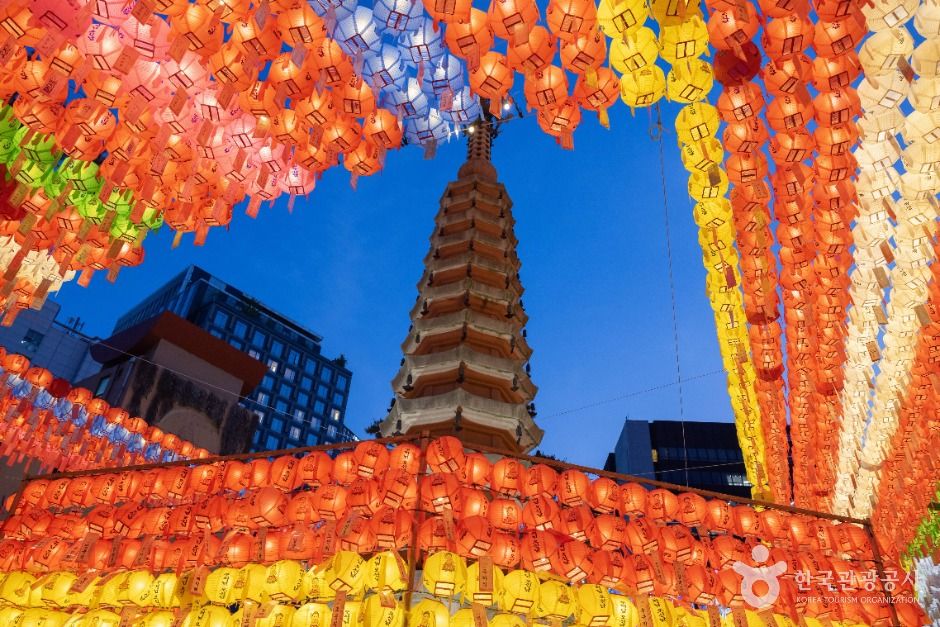
KTO says there is a seven-story stone pagoda in front of the main hall, built in 1930. It holds relics of the Buddha, which KTO says a Sri Lankan monk named Dharmapala brought to Korea in 1914. Stone lanterns stand on both sides of the pagoda.
The bell pavilion
KTO says that on the left side as you face the main hall there is a bell pavilion. It holds a large drum, a bronze bell, a cloud-shaped gong and a wooden fish, which are sounded during morning and evening ceremonies. KTO explains each as intended for a group of beings: the drum for four-legged animals, the bell for those suffering in hell, the gong for birds and the wooden fish for creatures that live in water.
Seasons
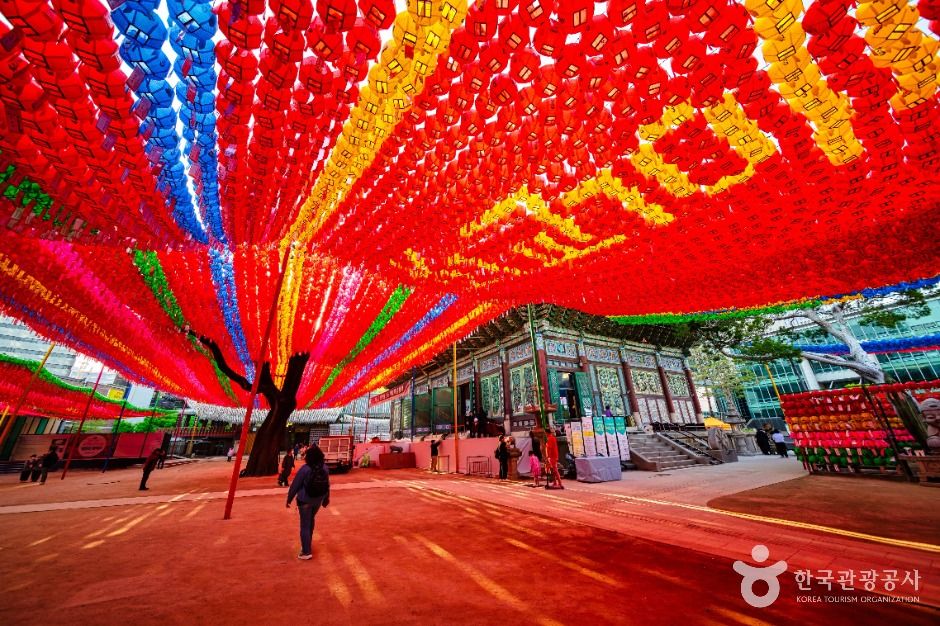
KTO says the grounds are filled with lanterns in spring, lotus flowers in summer and chrysanthemums in autumn. The photo below shows a canopy of lanterns over the main hall. Visit Korea says the annual lantern festival for Buddha’s birthday takes place at the temple, and we found no confirmed date for it. Check the official site before planning around it.
Inside the main hall
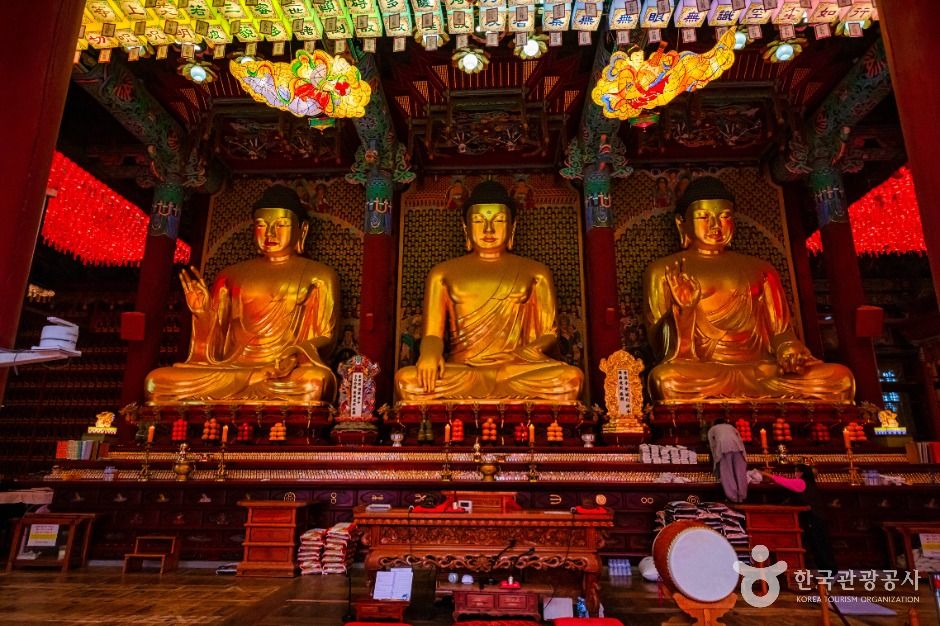
The KTO photo below shows three large seated golden Buddha statues inside the main hall. The Seoul city government’s English page also mentions three huge golden Buddha statues. We have no source on rules for entering the hall or taking photos inside, so follow posted signs and staff directions.
Hours and practical details
- Hours: KTO lists “open at all times” with no closing day. Visit Seoul says the grounds are open 24 hours, 7 days a week, but adds that opening hours vary depending on which Buddhist ceremonies are taking place and on the temple schedule.
- Admission: Visit Korea, KTO’s English site, lists admission as free.
- Parking: KTO lists parking as possible. Visit Korea lists 1,000 won for every 10 minutes.
- Phone: 02-768-8600 (KTO).
- Address: 55 Ujeongguk-ro, Jongno-gu, Seoul.
Getting there
Visit Seoul lists Jonggak Station on Line 1, Exit 2, at 413 m. A Seoul city government English page, which carries a registration date of 2014, lists Jonggak Station Exit 2, Anguk Station Exit 6 and Gwanghwamun Station Exit 2. That page is old, so we would check an exit map on the day. We did not verify walking times.
Nearby
Visit Seoul lists a Templestay Information Center about 80 m away, a temple cuisine restaurant called Balwoo Gongyang and the Mokin Museum, which focuses on traditional wooden sculpture and woodwork. The page also says the temple hosts a temple stay program. We found no schedule, prices or booking details, so contact the information center for those.
For more of central Seoul, see our Cheonggyecheon walk guide and our Jung-gu guide.
First-Timer Tips
These are our suggestions, not sourced facts.
- Treat it as a short stop and combine it with other sights nearby.
- Keep your voice down and follow any signs inside the hall.
- If you want a lantern view, check the festival dates first.
FAQ
Is Jogyesa free? Visit Korea lists admission as free.
Is it open every day? KTO lists no closing day. Visit Seoul lists it as open 24/7, with hours that vary by ceremony and schedule.
Which exit should I use? Visit Seoul lists Jonggak Station on Line 1, Exit 2. Another listing gives Anguk Exit 6 or Gwanghwamun Exit 2.
Is there a dress code? We found no source on this, so we cannot say.
What We Could Not Confirm
- Dress code, photography rules and visiting etiquette inside the main hall.
- Dates of this year’s lantern festival and other events.
- Templestay schedule, prices and booking steps.
- Walking times from each station.
- Whether all areas of the grounds are open at night.
Related guides
- Cheonggyecheon Stream: A Short City Walk
- Deoksugung, Namdaemun Market and Myeongdong: A Jung-gu Guide
We post short first-timer guides on Instagram too: @rolo.koreaguide.
Sources
Checked on 11 Oct 2026.
- Korea Tourism Organization, TourAPI (Korean service): Jogyesa (content ID 128144). Photographs (KOGL Type 1) used unaltered.
- Visit Seoul, Jogyesa Temple: https://english.visitseoul.net/attractions/jogyesa-temple_/2586 (page lists an edit date of 16 Sep 2026).
- Visit Korea (KTO), Jogyesa Temple: https://english.visitkorea.or.kr/svc/whereToGo/locIntrdn/rgnContentsView.do?vcontsId=111552 (undated).
- Seoul Metropolitan Government, Jogyesa Temple: https://english.seoul.go.kr/jogyesa-temple-2/ (registration date 2014).

