


The Busan National Science Museum (국립부산과학관) is an indoor option on Busan’s east coast, in Gijang-gun near the Osiria tourist complex. It is a useful backup if the weather turns, and it works for families with children. This guide covers the hours, the listed fees, the main areas and the route from the Donghae Line, and it lists what we could not confirm.
The original source checks were made on 2 October 2026. Admission, planetarium, booking and transport updates below were checked against the museum operator on 17 October 2026; other details retain their original source date. Personal notes from visiting with children are separate from the published practical information.
Our Family Visit: Water Play at Saessak Nuri
At the science museum, our 5-year-old became so absorbed in pumping water in Saessak Nuri Hall that their clothes ended up wet. We were visiting with a 3-year-old too, and this hands-on area was a highlight of the outing. It felt much closer to play than to following a museum route.
The practical lesson: pack a full change of clothes for Saessak Nuri, and book before you leave home. Our notes record advance booking on the website as essential for this hall; use the museum’s official ticket office to check current sessions. The operator says the hall is for young children with an adult and that ages 7 to 18 cannot enter, so plan separately for older siblings.
On the same day we also went to Andersen Fairy Tale Village in Gijang, where the children ran around the gingerbread-house sculpture. Our notes record that toilets were only at the entrance on our visit, so take children before you set off along the paths. We did not record the journey time between the two places.
Family notes added 15 October 2026. The visit date was not recorded. The children were aged 5 and 3 at the time.
What It Is
Visit Busan, the city’s official tourism site, says 1.14 million Busan citizens signed to establish the museum, and that its design is shaped like a ship. The Korea Tourism Organization (KTO) says the museum opened in December 2015, passed 7 million cumulative visitors, and marked its 10th anniversary in 2025. KTO says it averages about 1 million visitors a year. Those figures are KTO’s own and we did not check them.
KTO lists these parts of the museum:
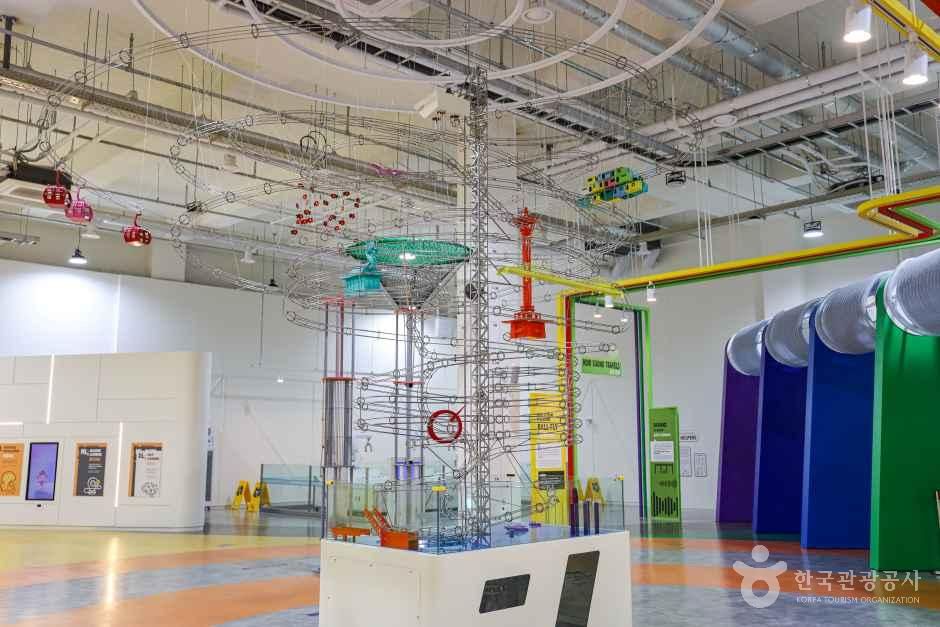
- a permanent exhibition hall with displays on cars, aerospace, ships, energy and health science;
- Saessak Nuri, a space-science playground for infants and toddlers;
- a children’s science museum with hands-on exhibits on basic science and future technology;
- a special exhibition hall called Kim Jin-jae Hall;
- a planetarium and an observatory with a refracting telescope;
- a science park, a small train, and an overnight science camp building.
From my own visits. I rank this among the top three museums in Busan to visit with children. Some exhibition areas are free, and the museum often holds events, so we spent a useful day there. Parking was easy to find when we went (see the charged parking note below). It also pairs well with Haedong Yonggungsa nearby: go to the temple in the morning and the science museum in the afternoon. Our family notes record many stairs at Haedong Yonggungsa, so we would take a baby carrier there rather than rely on a stroller.
What You See Inside
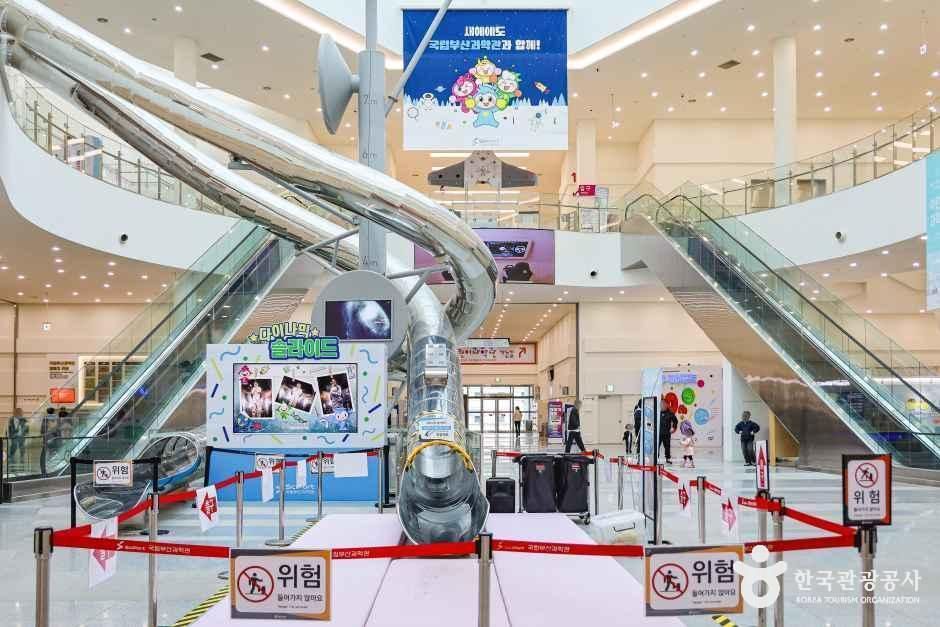
Visit Busan says the silver Dynamic Slide stretches from the second floor to the first floor of the main hall, and that small dancing robots stand at the bottom. It lists experience exhibits such as a walk on the surface of the Moon in zero gravity, a gyroscope, a seat belt simulator and an aviation simulator. It describes a planetarium where you can watch constellations on a large dome screen, even at midday.
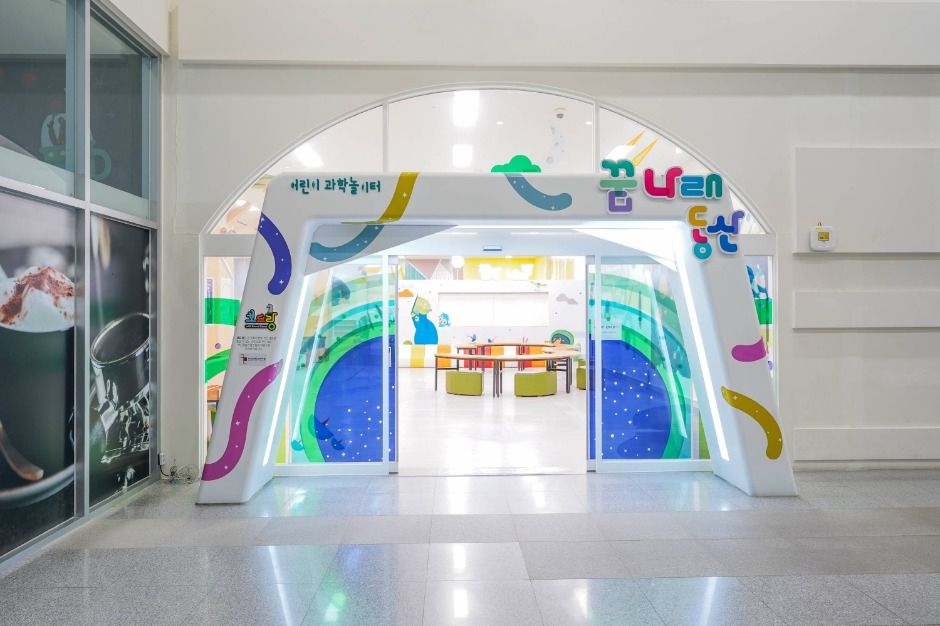
The operator says Saessak Nuri is for young children with an adult guardian; ages 7 to 18 cannot enter. The Children’s Science Museum and planetarium require visitors to be at least 3, with an adult accompanying young children. Individual rides can have additional height or age limits, so check each exhibit’s rules.
For adults, the museum is not only for children. KTO says the permanent halls show the science and technology of the Busan, Ulsan and Gyeongnam region’s industries, such as cars, ships and energy. KTO also says the museum keeps developing programs on artificial intelligence, robots and making, but we did not find a schedule for them.
Hours, Closing Days and Fees
The operator confirms Tuesday to Sunday, 09:30 to 17:30, with ticket sales ending at 16:30. Regular closures are Mondays, 1 January, and the days of Seollal and Chuseok. A public-holiday Monday is followed by a closure on the next day. Check special notices for your date.
- Permanent exhibition: KRW 3,000 for adults aged 19 to 64; KRW 2,000 for ages 7 to 18; under 7 free.
- Combined permanent and Children’s Science Museum ticket: KRW 4,000 for adults, KRW 3,000 for ages 7 to 18, and KRW 2,000 for ages 3 to 6.
- Parking: KRW 2,000 per day, paid by card on exit; published parking hours are 09:00 to 18:00. Discounts and exemptions have separate conditions.
Use the official individual ticket office to check available sessions and buy tickets. The operator says next-month bookings open around the 25th of each month. Events and education programs use their own website booking pages; do not assume one exhibition ticket includes them.
Planetarium Tickets and Sessions
The planetarium lists a standard KRW 1,500 ticket, admission from age 3, and 40-minute sessions. Children aged 3 to 6 need an adult. Its timetable, dated 14 July 2026 and checked on 17 October, starts at 10:00, 11:00, 13:00, 14:00, 15:00 and 16:30. Times and films can change. Wait on the first floor five minutes early; entry after a show starts is not allowed.
How to Get There
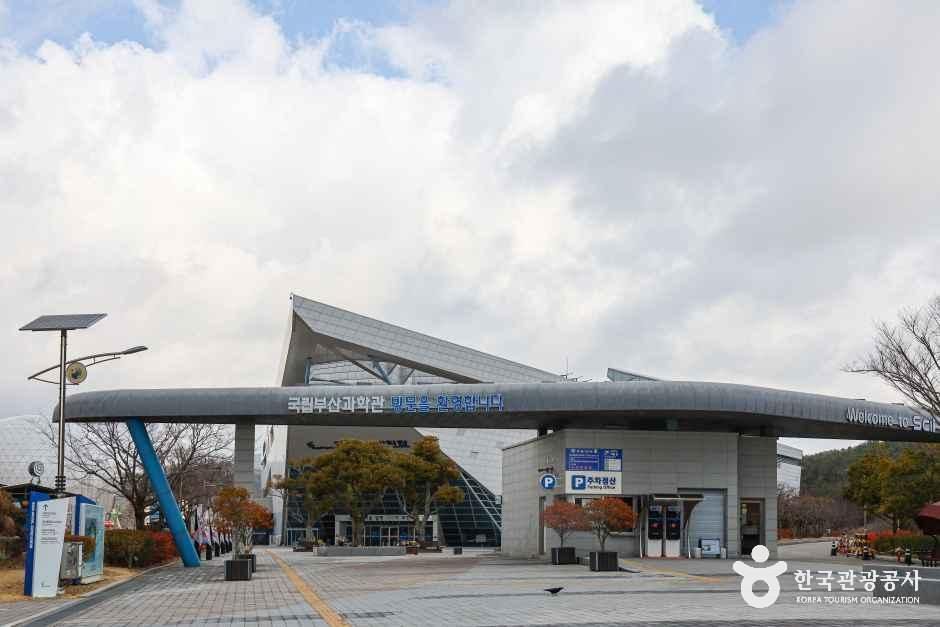
The museum operator now lists two connections from Donghae Line Osiria Station (오시리아역), Exit 1, to the main gate: the on-demand Tabara (타바라) bus, or BigAi Bus A01. A01 became a paid service on 9 March 2026; the published weekday window is 09:17 to 17:38, at intervals of 20 to 50 minutes. Check current availability before planning your return.
For buses 185 and 1001, the operator identifies the stop as Osiria Station / Busan National Science Museum Entrance (오시리아역·국립부산과학관입구), followed by a 25-minute walk. This is different from arriving at the main gate. The older Visit Busan description does not explain that final walk; use the operator directions and a live map when choosing a route.
The Donghae Line is separate from Busan Metro; check whether your pass covers it. See our Busan metro and T-money guide. For a nearby coastal outing, see our Songjeong Beach guide; no direct museum-to-beach journey time has been verified here.
First-Timer Tips
These are our suggestions, not sourced facts.
- Aim to arrive well before the 16:30 last entry. We have no sourced time that is enough for a visit.
- Choose your planetarium session before arranging transport; check special exhibitions separately.
- Bring a payment card if driving: the operator lists card-only parking payment. We have not checked every onsite payment method.
- On weekends, expect that the museum may be busy. We found no crowd data.
FAQ
Is the museum open on Monday? No. Both KTO and Visit Busan list it as closed on Mondays.
Is it free for young children? The operator lists free permanent-exhibition admission for under-7s; other attractions have separate age and ticket rules.
How do I reach it by train? Use Osiria Station Exit 1, then check Tabara or BigAi Bus A01 for the main gate. The operator lists a 25-minute final walk for the 185/1001 entrance stop.
Does it have a planetarium? Yes. The operator lists a standard KRW 1,500 ticket and 40-minute sessions for ages 3 and over; check the session list above and current availability.
What We Could Not Confirm
- Live seat availability, special-exhibition prices and event-specific booking conditions.
- Which experience programs have height or age limits.
- Live bus arrivals, weekend A01 availability and the final return service for your date.
- Whether there is an English audio guide or English signs.
- The best time of day for a visit.
Related guides
- Songjeong Beach and Jukdo Park Guide
- Haedong Yonggungsa, Jukseong and Daebyeon Guide
- SEA LIFE Busan Aquarium Guide
- Busan Metro for Visitors
We post short first-timer guides on Instagram too: @rolo.koreaguide.
Sources
Checked on 2 Oct 2026.
- Korea Tourism Organization, TourAPI (Korean service): Busan National Science Museum (content ID 2385666). Photographs from this listing, three KOGL Type 1 and one KOGL Type 3, used unaltered.
- Visit Busan (official Busan tourism site), Busan National Science Museum: https://www.visitbusan.net/index.do?menuCd=DOM_000000301001001000&uc_seq=340&lang_cd=en ; surfing page for the Songjeong bus 185 listing: https://www.visitbusan.net/index.do?menuCd=DOM_000000302008001000&uc_seq=338&lang_cd=en .
- The operator website was accessed on 17 October 2026 for the practical updates linked below; historical and unchanged descriptions retain the earlier source date.
- Distances: straight-line calculation from the KTO listing coordinates, not a walking or driving route.
Practical update checked 17 October 2026: Busan National Science Museum: admission, age rules and parking.
Practical update checked 17 October 2026: Busan National Science Museum: planetarium timetable.
Practical update checked 17 October 2026: Busan National Science Museum: online ticket office instructions.
Practical update checked 17 October 2026: Busan National Science Museum: current transport directions.

