


Olympic Park (올림픽공원) has more than one access window in its Korea Tourism Organization listing. The most useful planning rule is to match the hours to the way you intend to enter and the area you intend to use. Do not apply a later plaza closing time to every part of the park.
The KTO record retrieved on November 1, 2026 UTC, or November 2 in Korea, lists pedestrian and bicycle access as 05:00–22:00, with plaza access until 24:00. It separately lists vehicle access as 06:00–22:00. Its safety note identifies Peace Square and Meeting Square as the exceptions after 22:00. Recheck current arrangements before planning a visit around those limits.
Start with how you will arrive
The listed pedestrian and bicycle window starts at 05:00, while the vehicle window starts at 06:00. These are different statements about access. A walking opening time should not be used as proof that vehicle entry is available at that same time.
If you intend to drive, check the current vehicle arrangements and the entrance relevant to your plan. The tourism record says parking is available, but it does not provide a confirmed parking space, a current parking fee or a reservation. Saving the park’s general address is a starting point, rather than a complete parking and arrival plan.
The late plaza exception is limited
The distinction at the other end of the day matters just as much. The listing’s 24:00 plaza window does not mean that ordinary access throughout the park continues until midnight. Its separate note restricts entry after 22:00 except for Peace Square and Meeting Square for safety.
If you are considering an evening visit, identify the particular area you want to reach and check its current rule. Do not turn the names of two exceptions into an assumption about every lawn, path, historic area or venue. If you cannot establish that your planned area and route fit the actual access arrangements, change the timing rather than relying on the broadest number in the listing.
Choose the part of the park that interests you
KTO describes Olympic Park as a setting where the legacy of the 1988 Seoul Olympics shares space with green areas and historic remains from the Baekje period. Its description includes Mongchontoseong Fortress and Mongchonhaeja, a man-made lake, along with sports, cultural, ecological and history-related areas.
That range is a reason to choose a focus before arriving. You might be interested in the Olympic setting, the historic context or a green-space visit. These are different starting interests, rather than a promise that a single short route will cover everything. Check the location of your chosen area and the current entrance and exit you intend to use.
Treat broad duration advice as a guide
The official description presents Olympic Park as a large site and advises visitors to familiarise themselves with entrances, exits and routes before starting. That is useful advice even if you do not intend to explore the whole park.
The record’s broad description of a lengthy full exploration is not a requirement that every visitor must spend the same amount of time. Decide what you want to see, then make a plan that fits that interest and the current access window. This article does not supply a verified complete walking route or a personal journey duration.
Check individual activities separately
A general park listing is not a timetable for a concert, museum, sports venue or other individual activity. Even when a park area is accessible, that does not confirm that a particular indoor venue is open or that an event ticket is available.
The KTO description also mentions the Hodori road train beside Peace Square. This guide does not confirm its current service, timetable, fare or availability. If that service is essential to the way you intend to move around, verify it before depending on it. Do not use a general mention of a train as a substitute for planning the route you can actually use.
Use the photograph for context
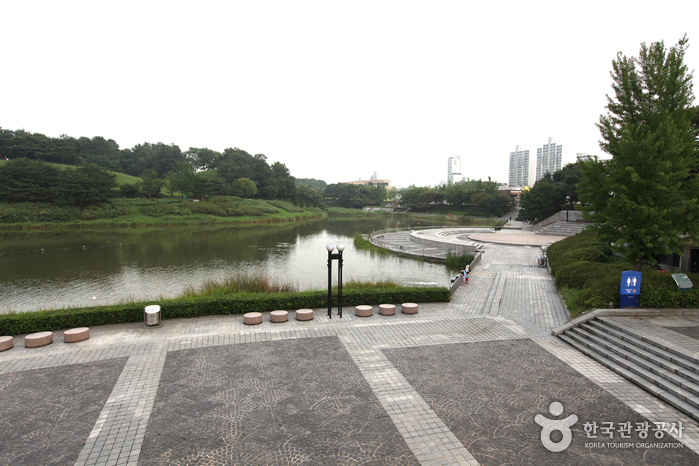
The original photograph attached to this article shows a paved approach beside a lake with trees in the park. It is an undated image. It provides a view of the setting, rather than confirmation of the condition or accessibility of every section on your visit.
The same caution applies to seasonal photographs of flowers or foliage. An appealing older view does not establish the scene on a later date. This guide does not promise a bloom, a particular weather condition or an unobstructed route. Check the aspect that matters to you instead of reading it into a photograph.
Save the access rules with the park name
KTO lists the address as 424 Olympic-ro, Songpa-gu, Seoul, and the contact number as +82-2-410-1114. Save the Korean park name as well as your chosen destination within it. A query about the specific area you need is more useful than assuming the park’s general opening information answers every access question.
- Pedestrian and bicycle access: listed 05:00–22:00.
- Vehicle access: listed 06:00–22:00.
- Later access: check the limited Peace Square and Meeting Square exceptions.
- Confirm your entrance, intended area and exit before setting off.
- Verify events, individual venues and train service separately.
- Recheck current operating rules for your actual travel date.
Source: Korea Tourism Organization, record retrieved November 1, 2026 UTC / November 2 in Korea. Hours and access arrangements may change. No booking, current event, train service or individual accessible route is confirmed here.

