


Gijang is at the north-eastern end of Busan and takes more travel time than city-centre stops (our suggestion). This guide covers three places along its coast: a temple built on the shoreline, a chapel that was made for a television drama, and a fishing port known for anchovies. Each fact has been re-checked against official sources.
Every hour, distance and phone number below comes from a named source, checked on 30 September 2026. Where sources disagree, we say so. Where nothing could be confirmed, we say that too.
Our Family Visit: The Temple Steps Changed the Plan
We visited Haedong Yonggungsa with our children, aged 5 and 3. The stairs were the practical issue for us: a stroller was not a workable way to follow the temple route we took. For a return visit with a child who needs carrying, I would bring a carrier rather than rely on the stroller.
Our Gijang outing also included Ahopsan Forest and eel rice at Chilam Manjang. Those are stops from our family notes, not evidence that we tested the Jukseong and Daebyeon route described elsewhere in this guide. I would decide how much to add after seeing how the children manage the temple steps.
Family notes added 15 October 2026. The visit date was not recorded. The children were aged 5 and 3 at the time.
Where to Go: A Temple, a Chapel and a Port
Haedong Yonggungsa Temple (해동 용궁사)
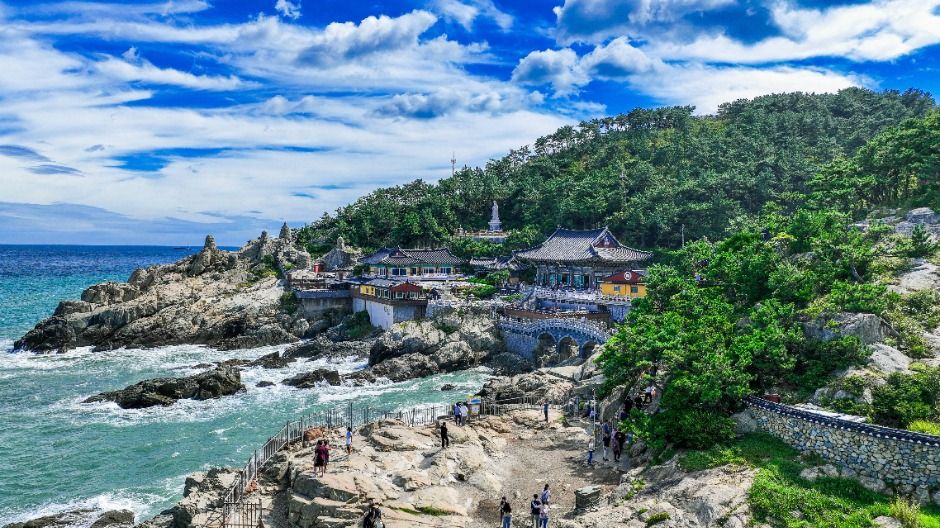
The Korea Tourism Organization (KTO) describes Haedong Yonggungsa as a temple on the coast of north-eastern Busan, and points out that most temples in Korea stand in the mountains, so a temple on the shoreline is a rare find. KTO says it was first built in 1376 by the Buddhist teacher Naong during the Goryeo dynasty, was destroyed during the Imjin War, and was rebuilt by the monk Ungang of Tongdosa Temple in the early 1930s. The temple’s name is said to come from a dream that the abbot Jeongam had in 1974, during a 100-day prayer, of Avalokitesvara Bodhisattva ascending to the heavens on a dragon’s back.
The address is 86 Yonggung-gil, Gijang-gun, Busan. Visit Busan, the city’s official tourism site, lists the same address and says admission is free.
Jukseong Church (죽성성당)
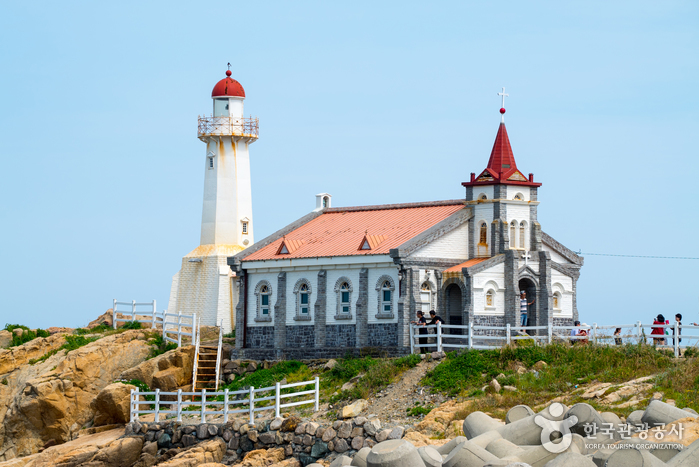
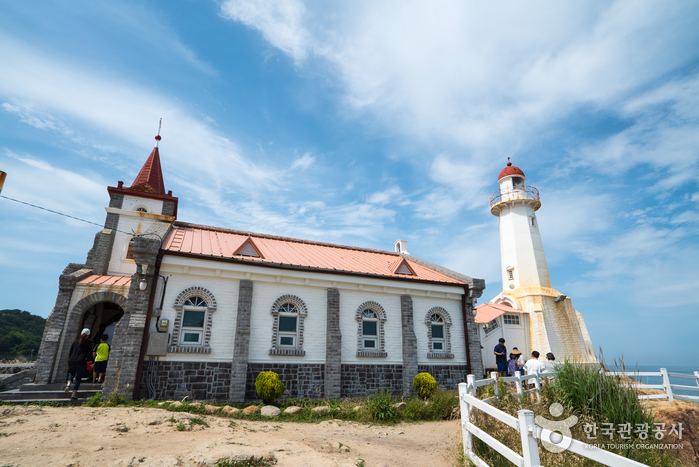
Jukseong Church looks like a small seaside chapel, but KTO says it is a drama set built for the SBS drama “Dream” (2009). So it was made as a filming set, not as a parish church. KTO adds that the inside is run as a gallery, and that visitors may find an exhibition on when they arrive. It describes a small fishing-village setting, white surf breaking over rocks against the red roof, and a picture-frame photo spot where many visitors queue.
KTO lists the site as open 24 hours, all year round, at Duho 1-gil, Gijang-eup, Gijang-gun. That covers the outside; it does not tell us when the gallery inside is open (see the confirmation list below).
Daebyeon Port (대변항)
Daebyeon Port is the third stop, and it is a working fishing port. The Gijang County English tourism page calls it a natural fishing village, rare in the south of the East Sea, well known for raw anchovy and raw cutlassfish, and says anchovy fishing boats line the entrance to the village.
On the size of its anchovy trade, the Korea Herald (11 March 2026, by Lee Yeon-jae) writes that Daebyeon Village and its port account for about 60 per cent of South Korea’s anchovy catch. The same article says fishers use vertical drift nets, lifted and shaken to release the fish, and that anchovies are caught mainly in spring and autumn. Some Instagram posts of ours used the wording “gill-net”; the Herald does not use that phrase, so we use its version here. It is a single newspaper figure, not an official statistic.
The TourAPI database we use for place data has no English entry for Daebyeon Port, so we have no KTO coordinates or opening hours for it.
What to Eat: Anchovies at Daebyeon Port
Daebyeon is a working port, and official pages say seafood restaurants and stalls operate around it.
The Gijang County page says fresh raw anchovy and anchovy stew can be enjoyed at Daebyeon Port. Visit Busan says seafood restaurants and food stalls line the area around the port, with the dishes named as sliced raw anchovy, anchovy stew, anchovies with vegetable wraps and rice, grilled anchovies, deep-fried anchovies and salted anchovies. It describes the stew as spicy yet soothing.
The Korea Herald says spring anchovies star in anchovy sashimi, grilled anchovies and anchovy stew, and that the spring catch, at 7 to 15 centimetres, is especially sought after. This guide is dated 30 September, in the autumn part of the season. The sources say anchovies are caught in both spring and autumn, but none we checked says what is available on a given day. Ask at the port.
As for the annual festival, our two official sources conflict. The Gijang County English page says an anchovy festival is held every year in April, with anchovy netting and free tastings. Visit Busan says the festival is normally held in early May and that Gijang has hosted it since 1997. Either way it is well past for this year, and we have no 2026 dates.
We have no named restaurant at Daebyeon Port, and no prices or opening hours, so we cannot recommend a specific place there. If you are allergic to fish or shellfish, or avoid raw food, ask staff about ingredients; we have not verified allergen or hygiene details for any stall.
One restaurant listed by KTO nearby
KTO’s TourAPI lists one Gijang restaurant with full details, though we have not confirmed it is open today: Gijang Jonggajip Gomjangeo (기장종가집곰장어), at 72 Gijanghaean-ro, Gijang-eup. KTO says it serves inshore hagfish (gomjangeo), which it describes as unfamiliar to many foreigners but considered a health food, in salted, seasoned or “brown straw” versions, with kimchi pancake and side dishes, and it suggests adding fried rice after the seasoned dish. It is open 10:30 to 21:30 (last order 20:30), all year, with parking, and the phone number is +82-51-722-8958.
This is a separate option from the anchovy port. By the coordinates in the KTO data, it lies about 1.1 kilometres in a straight line from Haedong Yonggungsa, but we have no route information. The “health food” wording is KTO’s description, not a claim we can support.
Plan Your Visit: Getting Around Gijang
Reaching the temple
Visit Busan gives this route: leave Osiria Station on the Donghae Line by Exit 1, take bus 139 from the station and get off at Haedong Yonggungsa Temple. It lists the opening hours as every day 04:30 to 19:20, last entry 18:50, which matches the KTO listing. Parking at the temple is charged. The information line is +82-51-722-7744.
Visit Busan also lists a route from Exit 7 of Haeundae Station on Metro Line 2, changing to bus 181, 100 or Haeundae 9, and a Busan City Tour Bus route (re-read 1 October 2026). Some of our Instagram posts also named express bus 1001, a stop called “Yonggungsa Institute of Fisheries Science” and a walk of about 15 minutes; the official page confirms none of these, so we treat them as unconfirmed.
Not a walking route
The three places are spread along the coast. We do not have Daebyeon Port’s coordinates, but the KTO coordinates put Haedong Yonggungsa and Jukseong Church about 6.3 kilometres apart in a straight line (our calculation, not a walking distance). Our suggestion is to plan a bus or taxi for each leg and check the route on a map app before you go. We found no published travel times between the stops, so leave some slack in the day.
An optional easy walk
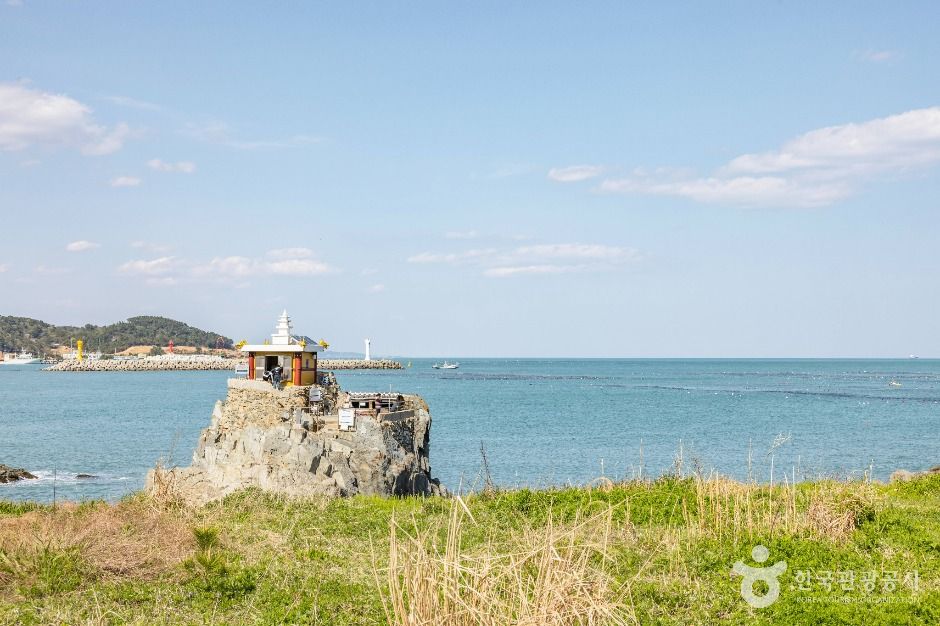
If you have spare time near the temple, KTO lists the Osiria Coastal Walk (오시리아 해안산책로) in Sirang-ri, Gijang-eup. It describes sea views, plenty of resting stops, a wildflower path leading into a pine forest, and a shrine to the Dragon King. It is listed as open 24 hours, all year, with no parking, and the information line is +82-51-709-4000. The KTO coordinates put it about 1.2 kilometres in a straight line from the temple. Calling it a flatter, easier walk than the temple’s stairs is our suggestion: KTO calls it family-friendly but does not compare the two.
A workable order (our suggestion)
- Go to the temple early. It opens at 04:30, and the last entry is 18:50.
- Take a bus or taxi to Jukseong Church.
- Add Daebyeon Port if you want to see the fishing boats and try anchovy dishes.
- Keep the Osiria walk as an option if you have time left.
First-time visitor tips
- Treat the temple as your anchor. Our suggestion: it has the most confirmed information, with hours of 04:30 to 19:20 and free admission, so start there.
- Do not plan to walk between the three places. The temple and Jukseong Church are about 6.3 kilometres apart in a straight line, so budget for a bus or taxi on each leg.
- Leave slack in the day. We found no published travel times between the stops, so a loose plan is safer than a tight one.
- Ask at Daebyeon Port rather than expecting a set menu. We have no named restaurant, prices or hours there, and none of our sources says what is available on a given day.
- Skip the Osiria walk if you are short of time. It is optional and listed as open 24 hours.
FAQ
Is Haedong Yonggungsa free?
Yes. Visit Busan says admission is free, though parking at the temple is charged.
What are the temple’s opening hours?
Visit Busan lists every day from 04:30 to 19:20, with last entry at 18:50, matching the KTO listing. The information line is +82-51-722-7744 if you want to check before you go.
How do I reach the temple by public transport?
Visit Busan gives a route from Osiria Station on the Donghae Line: leave by Exit 1 and take bus 139. A second route runs from Haeundae Station. We could not confirm any other bus numbers.
Can I go inside Jukseong Church?
Not reliably. KTO says it is a drama set with a gallery inside and lists the site as open 24 hours, but it gives no gallery hours. An exhibition may or may not be on.
Is there an anchovy festival I can attend?
Not this year. Our sources conflict on April or early May, and either way it has passed. We have no 2026 dates.
What We Could Not Confirm
- Anything about the Daebyeon market itself: opening hours, named stalls or restaurants, prices, and whether it is best in the morning “when boats come in”, which no source we checked says.
- Seasonal detail: whether the autumn catch is smaller than the spring one (some of our posts said so; the sources do not), and what is on sale today.
- Salted anchovy paste, dried seaweed and kelp as market goods. Visit Busan lists salted anchovies among the dishes, but we found nothing on paste, seaweed or kelp.
- The 60 per cent figure. It comes from one newspaper, and we found no official statistic. The Herald says “drift nets”, not “gill-net”.
- The extra directions: bus 1001, the stop name and the 15-minute walk from the stop.
- The 2026 anchovy festival dates, and whether it is held in April or early May.
- Jukseong gallery hours. KTO says a gallery operates inside but gives no hours.
- Photo spots at the temple (the Haesu Gwaneum Daebul statue, the 12 zodiac statues and Yongmun Bridge) mentioned in our Instagram posts: not re-checked.
- Travel times and fares between the three stops.
- How close Daebyeon is to the temple: our posts said “a short ride”. We did not confirm that.
Before You Go
Gijang works as a coastal day out if you accept that it needs transport between the stops. Check the current hours by phone (temple: +82-51-722-7744), keep the schedule loose, and treat Daebyeon as somewhere to look around and ask about anchovy dishes on the spot, since we could not name a restaurant there.
For a quick card version of this guide, follow @rolo.koreaguide on Instagram.
Related guides
Sources
- Korea Tourism Organization, TourAPI (English service): Haedong Yonggungsa Temple (content ID 264404), Jukseong Church (Filming Set) (2947862), Gijang Jonggajip Gomjangeo (3400947), Osiria Coastal Walk (3521718). Checked 30 Sep 2026. Photographs: KTO, KOGL Type 3 (temple, Jukseong, Osiria), used unaltered.
- Visit Busan, Haedong Yonggungsa Temple access and practical information: https://www.visitbusan.net/en/index.do?menuCd=DOM_000000301001001000&uc_seq=261&lang_cd=en (fetched 30 Sep 2026; Haeundae route, bus 139 and hours re-read 1 Oct 2026).
- Gijang County, Daebyeon Fish Village: https://www.gijang.go.kr/eng/index.gijang?menuCd=DOM_000000503004002000 (fetched 30 Sep 2026; April festival wording re-read 1 Oct 2026).
- Visit Busan, The Taste of Gijang: Anchovy and Seaweed: https://visitbusan.net/index.do?lang_cd=en&menuCd=DOM_000000302003001000&uc_seq=532 (fetched 30 Sep 2026; early-May festival wording re-read 1 Oct 2026).
- The Korea Herald, “In Busan’s Gijang, spring comes with anchovies”, 11 March 2026: https://www.koreaherald.com/article/10692172 (fetched 30 Sep 2026).
- Distances: straight-line calculations from the coordinates in the KTO data.

